Fort George and the railway boom: how Prince George began
Simon Fraser’s 1807 fur post, the South Fort George and Fort George rivalry, the Grand Trunk Pacific’s 1914 arrival and 1915 incorporation.
Updated
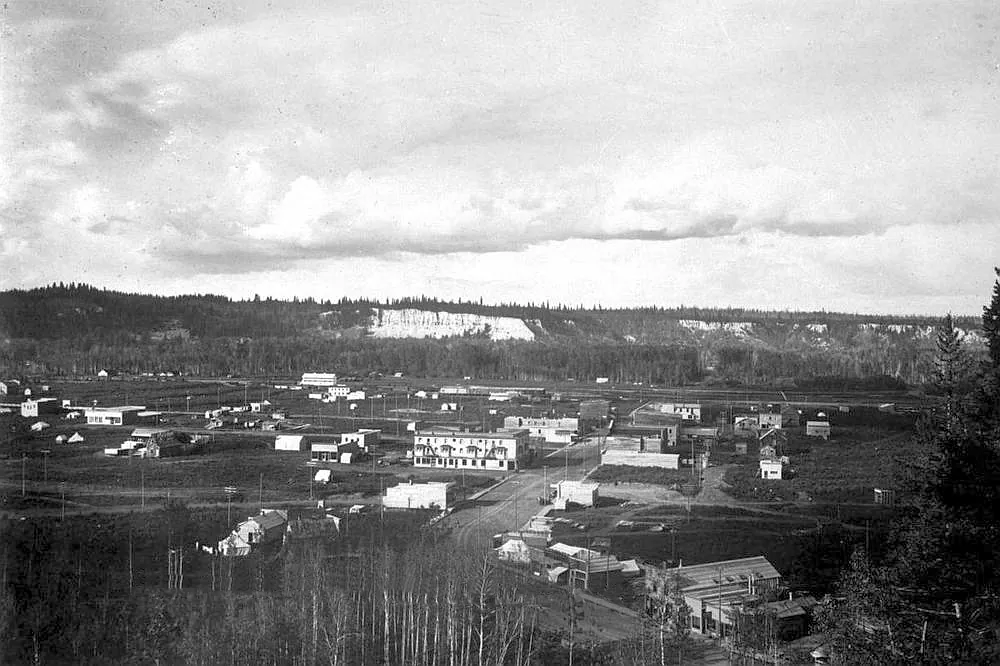
At a glance
- Simon Fraser of the North West Company founded the Fort George fur post in 1807.
- Two rival townsites, South Fort George and Fort George, were surveyed in 1909 in anticipation of the railway.
- The Grand Trunk Pacific bought the 1,366-acre reserve between them and built its own townsite, Prince George.
- The first westbound train arrived on January 30, 1914; the transcontinental line was completed that April.
- Prince George incorporated on March 6, 1915; Central Fort George joined in 1953 and South Fort George in the mid-1970s.
Few Canadian cities were born out of such a scramble. In barely six years, the confluence of the Fraser and Nechako rivers went from a sleepy fur post to three competing boomtowns, and then to a single railway city with a royal name. Here is how it happened.
1807: Simon Fraser’s Fort George
In 1805 the North West Company sent Simon Fraser west of the Rockies to set up trade and find a river route to the Pacific. His party built posts at McLeod Lake, at Stuart Lake (Fort St. James, 1806) and, in 1807, near the mouth of the Nechako. He named it Fort George after King George III. The next year Fraser set out from here on his famous descent of the river that now carries his name.
The fort sat in the homeland of the Lheidli T’enneh, who became its trading partners. After the 1821 merger of the fur companies, it became a Hudson’s Bay Company post. For most of the century it was a modest outpost overshadowed by Fort St. James, the headquarters of the New Caledonia district.
1903–1909: Railway rumours
In 1903 came news that changed everything. The Grand Trunk Pacific Railway (GTP), a new transcontinental line from Winnipeg to a Pacific port at Prince Rupert, would cross the Fraser near the old fur post. Settlers began arriving in 1906, and by 1909 two land companies were racing to build the town that would welcome the railway.
Three townsites, one station
South Fort George
The Northern Development Company bought land beside the HBC post along the Fraser in 1909 and began selling lots in 1910. South Fort George had one big advantage: the river. Sternwheelers of the BC Express Company steamed up from Soda Creek and tied up at its landing, and it quickly became the busy commercial heart of the area. Around ten paddlewheelers served the upper Fraser during the boom.
Fort George (Central Fort George)
About 3 km to the northwest on the Nechako, promoter George Hammond and his Natural Resources Security Company bought nine district lots and marketed “Fort George” across Canada and Britain. His advertisements promised a future railway metropolis with mild winters and endless farmland, and sometimes showed buildings that did not yet exist. Lots that sold for about $400 in 1912 were fetching $500 to $1,000 a year later.
The railway’s own town: Prince George
By 1913 each rival townsite had roughly 1,500 people, and each was certain the station would be theirs. The GTP had other plans. It wanted the flat, 1,366-acre Fort George Indian Reserve No. 1 that lay between them, and after years of pressure the Lheidli T’enneh agreed to its sale in 1911. The community was moved in 1913 and their village burned, a painful chapter explained in our Lheidli T’enneh guide.
Charles Vance Millar, owner of the BC Express Company, had been negotiating for the same land. The railway compensated him with 200 acres, which became the Millar Addition. Boston planners Brett and Hall drew up a street plan with a grid rotated toward the river, and the land was cleared in May 1913. Many downtown streets were named after Canadian cities and provinces.
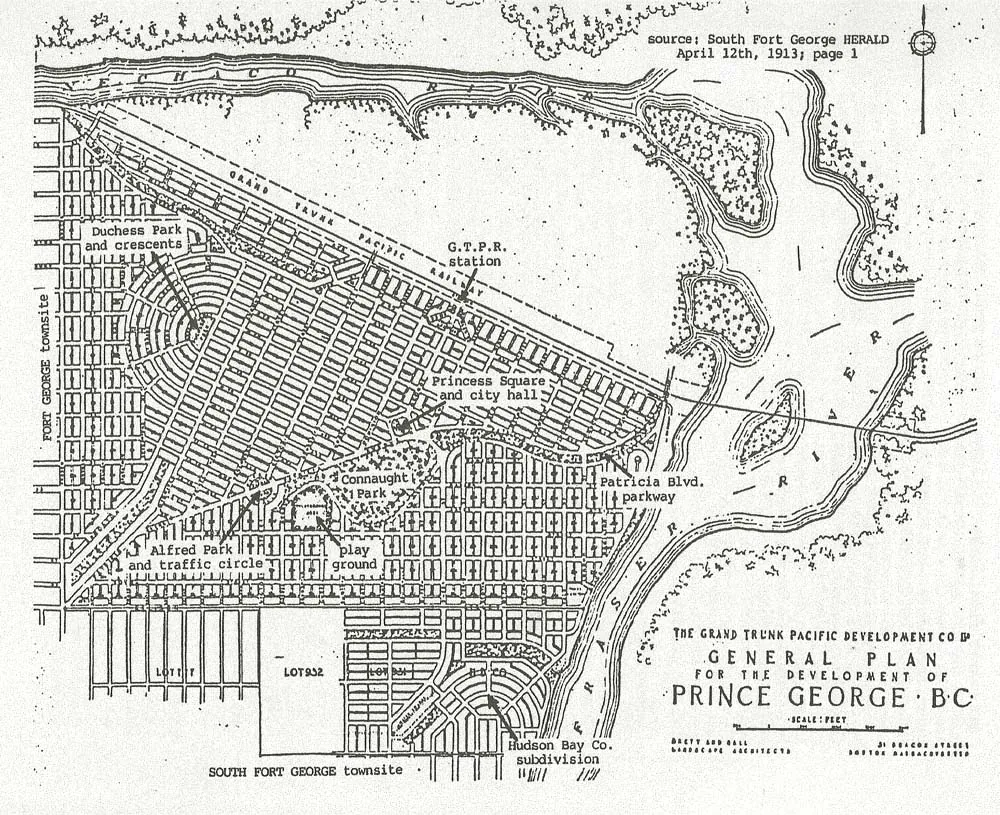
1914: The trains arrive
The construction contractors ran the first westbound train into Prince George on January 30, 1914. That spring the rails from east and west met near Fort Fraser, completing the line from Winnipeg to Prince Rupert. Scheduled passenger service linking Prince Rupert, Prince George and Edmonton began that September.
Hammond fought bitterly in court for a station at Fort George, but the railway would not budge. Businesses read the writing on the wall, and many buildings were jacked up and rolled from the old townsites to new lots in Prince George.
One small survivor of the era is still in town: a 2-foot-gauge wood-burning steam locomotive built in 1912, which came upriver by sternwheeler and worked on railway construction. Nicknamed the “Little Prince,” it has pulled the Fort George Railway at The Exploration Place in Lheidli T’enneh Memorial Park. Check the museum for current operating days.
1915: A city is incorporated
All three communities explored incorporating together, but the negotiations fell apart. The railway’s land alone was incorporated as the City of Prince George on March 6, 1915. Fort George merchants petitioned the province against the new name, without success. In a May 1915 plebiscite, residents approved “Prince George” by 153 votes to 13.
Where did the name come from? The railway offered different reasons at different times: to avoid confusion with Fort George, to honour King George V, or to honour his son Prince George, later Duke of Kent.
After the boom
The timing could hardly have been worse. The First World War began months after the railway opened, work on the Pacific Great Eastern line to the south stopped, and the population fell sharply. Yet the three pieces slowly came together:
- Central Fort George joined the City of Prince George in 1953.
- South Fort George stayed separate until boundary expansion in the mid-1970s.
- The Pacific Great Eastern finally arrived from the south in 1952, connecting with the CN main line and fulfilling the old promise of a northern hub.
The GTP itself went bankrupt and was taken over by the government in 1919–1920, becoming part of Canadian National. CN’s line through Prince George remains a busy freight corridor to the port of Prince Rupert, and VIA Rail’s Jasper–Prince Rupert train still stops here. See getting here and around.
Where to see this history today
- Lheidli T’enneh Memorial Park: site of the fur post and the old village, with The Exploration Place museum.
- South Fort George: walk the streets near the Fraser where the sternwheelers once docked.
- Millar Addition and Central Fort George: older neighbourhoods with roots in the boom years. See neighbourhoods.
- Central BC Railway and Forestry Museum: vintage rolling stock and railway buildings next to Cottonwood Island Park.
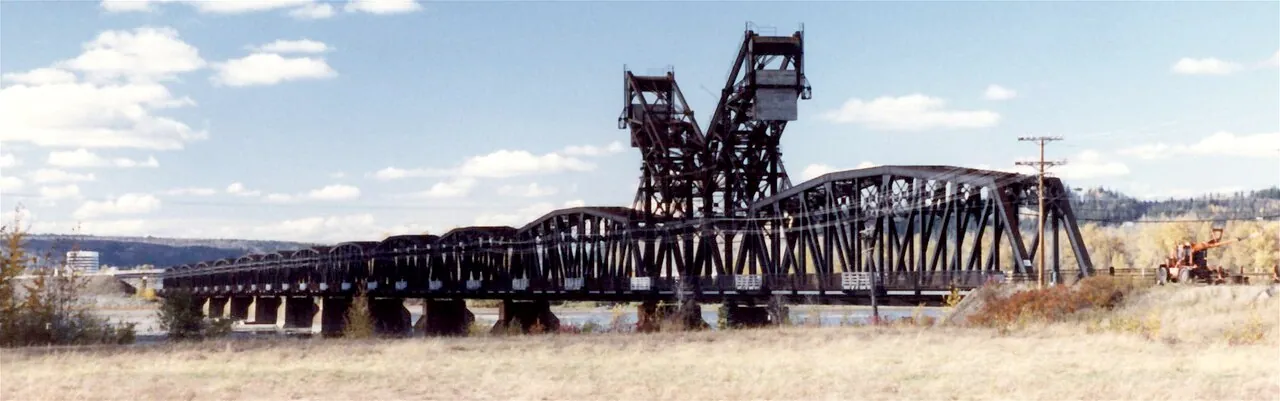
- The Grand Trunk Pacific bridge: the rail bridge over the Fraser, built in 1914, is still in use.
Continue with the full history of Prince George.
Common questions
What is the difference between Fort George and Prince George?
Fort George was first the name of the 1807 fur trading post, then of a speculative townsite on the Nechako River. Prince George was the Grand Trunk Pacific Railway’s own townsite, built between the older settlements and incorporated as a city in 1915.
Where was the original Fort George trading post?
Near the confluence of the Fraser and Nechako rivers, on land that is now Lheidli T’enneh Memorial Park in the southeast part of the city.
When did the railway reach Prince George?
The construction railhead reached the city in January 1914, and the Grand Trunk Pacific’s line between Winnipeg and Prince Rupert was completed with a last spike near Fort Fraser in April 1914.
What is the Millar Addition?
A 200-acre district near downtown that the railway gave to Charles Vance Millar of the BC Express Company, who had been negotiating to buy the reserve land himself. It is one of Prince George’s oldest neighbourhoods.
Sources
Official links
More in explore pg
- History of Prince George, BCA timeline of Prince George history, from the Lheidli T’enneh homeland at the confluence to a fur post, a railway boomtown and a northern capital.
- Lheidli T’enneh First Nation: people of the confluenceThe Lheidli T’enneh, on whose traditional territory Prince George stands: their name, history, the 1913 removal and Lheidli T’enneh Memorial Park.
- Glacial Lake Prince George: why the city sits in a bowlHow ice sheets, a vanished glacial lake and two rivers carved the Prince George bowl, its silt cutbanks and the benches the city is built on.
- Geography of Prince George: rivers, plateau and forestWhere Prince George sits: the Fraser–Nechako confluence, the Interior Plateau, sub-boreal spruce forest, Tabor Mountain, lakes and the Arctic divide.
- Prince George climate: weather by month, records and normalsPrince George climate normals for 1991–2020: monthly highs and lows, snowfall, rain, sunshine and record temperatures, plus tips for every season.
- Prince George neighbourhoods: a guide to the city’s areasA guide to Prince George neighbourhoods: Downtown, the Crescents, the VLA, College Heights, the Hart, South Fort George, Miworth and Blackburn.